Sunday, March 7, 2010

Sunrise, flights and adventures

Flight up to Puerto Montt

Today we took a flight up from Punta Arenas Chile to Puerto Montt at the southern tip of the Chilean Lakes district.  The flight was cheaper than the 36 hour bus ride we could have taken (and so much easier) but it was hard to wake up for the 6 am departure, especially when you're used to sleeping in till 9 am every day. :)  The flight was beautiful though.  We saw all of the chilean patagonia from the air and also a beautiful sunrise!  Glaciers look so much like rivers when seen from 40,000 feet up.  The highlight though was seeing Mount Fitz Roy (see our pictures of Chalten) from the air and seeing how it really stood out from all the peaks around it.  We were too tired to take pictures (plus they're never good from a plane window unless of course you're jumping out of the plane like my brothers Luke and Thomas did. :)  Still trying to figure out what to do next...

~Mike

Sunrise at Torres del Paine

The word sunrise has always had a romantic connotation for me.  If I closed my eyes and pictured a sunrise it would be on a beach at dawn.  Two silhouettes watching as the sun effortlessly rises before their eyes slowly and casts its light on the water.  Perhaps this is why I was so easily convinced of the need to be at the mirador of Torres del Paine at sunrise even though we had already hiked up to the same location one day earlier.  The guidebooks recommended it and Michael was eager to document the promised beauty.  How romantic it would be to share such a moment.

As I lay there in the tent at 5AM, I began to question whether or not the mission would be worth it.  I strained to listen for a furious wind or rain that would force us to abandon the mission and get more sleep.  Michael had mentioned the night before that he could always go by himself.  However, I knew I wouldn't be able to sleep knowing he would be bouldering up there by himself.  So I placed my shoes on my feet and turned on my headlamp determined to give it a chance.  I was surprised at how dark it was as our small beams of light showed us only part of the trail.  Together we proceeded with extreme care. As I was thinking about how crazy we must be to climb in the dark I noticed other headlamps on the pilgrimage to watch the sun illuminate the granite towers.  The first light of morning helped our progress and confirmed that clouds would not ruin the view.  We hoped that we would make it to the top before the sun rose over the hills.  I was hopeful that the trip wouldn't be in vain as we climbed upwards.  Finally at the top it was a great relief to sit and enjoy the surroundings as we waited for the sunrise.  We had made it in time and our effort was about to pay off.  As the towers began to change colors to shades of orange and red before our eyes it was a beautiful scene.  The journey had been worth it to arrive at this moment together.

As for my romantic visions of watching the sunrise together I had not fully considered the journey before arriving at that moment.  The journey to the sunrise turned out to be more like a romance than romantic.  For some people love arrives effortlessly and they are simply in the right place at the right time.  The miracle unfolds right before their eyes like a sunrise on the beach.  For others there is considerable effort.  The journey begins with both parties looking at the conditions weighing the probability for success in the end.  Throughout the journey you wonder if you or the other person is going to get hurt.  Will the journey be worth it?  Hope helps to sustain forward progress as you wonder if you are crazy.  What if one of you turns back? If you do in fact reach the top together then it comes down to fate.  How romantic it is when the timing is just right and the magic begins – the sunrise at Torres del Paine.

~Suzanne  

Wednesday, March 3, 2010

Torres Del Paine

Well, we're alive and much to the relief of our family and friends (and us) we were not in the earthquake zone in the north of Chile.  We didn't even know about the earthquake until the 28th (Sunday) of February and we were in a campsite with no real communication to the outside world, so all we heard were rumors of a 9.0 earthquake striking Santiago.  Images of Hati and the devastation caused there came to our minds and we hoped the same thing had not happened in Santiago.  Our friend Beatrice has parents that live in Santiago and we also hoped that they were ok.  In the end it seems like the damage is extensive but not crippling to this small developed country, or at least I hope so, and the country has ample reserves from the copper boom from the past years to help pay for reconstruction.  Needless to say, this is likely to have an impact on our travel plans.  We were planning on going north from here (Puerto Natales) to Puerto Montt and from there up through the main populated region of Chile including Santiago.  Now we're not really sure.  Should we keep to our schedule?  Surely the tourist industry has been hit hard and not going would exacerbate the problem, but if we do go, what would we really do?  Suzanne had an idea of helping out with relief efforts, which is a possibility, but I'm not sure how we would do this, so we'll need to do some research and see if we can.  In the meantime we can tell everyone about our time at Torres del Paine.

Torres del Paine is considered to be the most famous national park in South America.  It is a nature-lover's dream come true.  The main feature is a (relatively) small set of peaks independent of the Andes mountain range made of granite and sedimentary rock that shoot directly out of the earth like a massive cathedral.  Since its relatively small, you can actually hike around the peaks and up the valleys to get up close and see these peaks up close.  This is what we did.  We rented camping equipment and bought some food and began a five day backpacking adventure around the spires.  Day 1 we got up early and hopped on a bus to the park and began our hike up the first valley where you can best see the Torres or towers.  We'll let the pictures describe them.  The first day's hike was very difficult.  We had not been backpacking since the Conundrum trip a couple of years ago and that was only a couple of days and our packs seemed really heavy!  It also didn't help that the national park doesn't seem to really believe in switch-backs or anything so the hike up the valley was pretty much straight up the valley!  We eventually made it up to our campsite, which was very close to the mirador (viewpoint) of the torres.  I had read that it is very special if you can see the torres at sunrise, especially a red sunrise so our goal was to get close and hike up the last 450 meters (bouldering this time) to the mirador.  But since you never know what the weather is going to give you we decided to do the hike up there on our first day as well since the weather was looking ok.  So we hiked up that mountain twice, once on day 1 (but thankfully without our packs) and again on day 2 (this time in the dark before sunrise).  We were very blessed though in that both times the weather worked out fine and we got to see the torres in all their glory.  I also got some good sunrise shots!

So day 2 started out with a difficult hike without packs and then we headed for a very long hike to the next campsite.  This day wasn't as difficult with elevation climbs as the day before but it was about twice as long!  We didn't get to the next campsite until 6 pm (with a wakeup time of 5:30am!) so we were very very tired.  Along the hike though we did get a good view of the Cuernos peaks which are much more massive than the torres.  It was also very windy.  At one point we took the sleeping pads off our packs and hand-carried them because they were catching the wind and were almost knocking us down!

Day 3 started with us sleeping late in our tent from exhaustion from the day before.  We then headed up valle frances to a campsite at the base of the valley.  We went ahead and set up our tents and then without our packs we hiked up the valley for some amazing views of the cuernos, torres and surrounding mountainscapes that were just truly spectacular!   There are glaciers everywhere along the valley and on the way down we got to see one amazing sight.  One of the glaciers near the top of the mountain suddenly burst out a huge waterfall of ice and water covering the rocks below.  Then as quickly as it started it stopped, but we got to watch the effect of all that water all the way down the mountain as the normal waterfalls (which were everywhere) swelled to twice their size for a couple of minutes and then returned to normal.  I took a panoramic video of the whole valley so hopefully it can convey what we saw, but I'm afraid it will fall short.  It's hard to capture the massiveness of these mountain on a video or a picture (though of course we took plenty of attempts).

That night, after eating our hot-dogs and rice casserole, Suzanne got sick in the middle of the night and (in her words) between her being “trapped” in her mummy sleeping bag and being unable to open the tent, she was unable to direct the result of this sickness outside the tent and thus sprayed it all over the inside.  Needless to say, I was awake in a moment.  Why is it always hot dogs?  We did our best to clean it up and tried to go back to sleep.  The next morning she still wasn't feeling well so we decided to do only an 8 km hike to the next campsite instead of the planned 18 km.   We would then have access to running water and do a thorough cleaning of our sleeping bags and tent.  So poor sick Suzanne had to strap on her pack again and endure another hike but she was a trooper and we made it in 3 hours.  We set up camp and cleaned everything up and got it all dried (thanks to a sunny afternoon)  and had a relaxing evening.  The next day we hopped on a boat and headed back to civilization.

Overall it was an exhilarating and exciting adventure and we both really enjoyed it.  Suzanne was great!  This is not exactly her thing but she did it for me and I think she's got quite a bit of “I did Torres del PAINe with you, so you can do this for me” stored up for use later, but I think it was all worth it. :)  We're next going back to Punta Arenas to hopefully catch a flight to Puerto Montt in the Chilean Lakes District, assuming the flights are working in the country by then.  Some other observations:

You should really have a good idea of your meals and only bring that food, especially when you can buy food (albeit expensive) at some of the campsites.  We brought a full 1 and ½ day's food extra and we definitely noticed the weight.  Other things you don't need:  cards, dried milk.

I would love to come back and do an even longer hike (there's a full circuit around the peaks) and when I told Suzanne of this, she suggested it would be a great adventure with my brothers (i.e.  Not her).

~Mike

ps.  Pictures are uploading but they're a bit slow so check back in a day or so from this posting.
Pictures


Sunday, February 21, 2010

Ushuaia, the southern-most city in the world

We arrived here on Saturday and man was it cold!  It felt like winter and yet it's the middle of summer!  We got to our place, a nice Bed & Breakfast run by a friendly couple whose boys are all grown up.  We were exhausted from our 13 hour bus trip from Rio Gallegos.  Rio Gallegos isn't really that far away but Ushuaia is on an island and the quickest and cheapest way onto the island is a ferry, which is controlled by Chile.  The process of crossing into Chile (for a travel time of only one hour) took at least three!

After relaxing on Sunday we went to a couple of museums, the coolest of which was the old prison that was here.  Argentina had tried to turn this place into a penal-colony a la Australia but in the end just put a prison down here.  People didn't really try to escape because there was nowhere to run.  Overall the museum was very good, and hopefully the pictures and videos we took are enjoyable.

Suzanne is going to finish this one for me since I'm lazy. :)  ~Michael

So let's see. . .yes we filmed a little video in the old wing of the prison that you should check out if you have the time.  The crazy thing about the prison was how much of a difference they made to the city of Ushuaia.  The prisoners were responsible for building roads, the train line to the forest, laid electrical lines, and built many of the cities civic buildings.  Some of the prisoners were transferred to this prison because they had special skills (mechanics, engineers, etc.), others were brought here because they were literally insane (mass murderer that killed many children under 6 years old), or political prisoners (who oftentimes were just forced to stay in the city of Ushuaia but were not in the prison or under house arrest).  It is amazing how much good the prison brought to the town.  We were contemplating how this could work elsewhere.  One thing that Ushuaia really had going for it is that if people escaped they usually returned to the prison rather than die of starvation and cold.  Only those that had good behavior were allowed to work outside the prison and these were guarded by one or two people.  Regardless, it was very informative about the history of the town during the time the prison was open from 1902 to 1947.

We also went to another museum the Museo Fin del Mundo where we learned more about the maritime history, the native Yamana people, and saw the animals of the region (stuffed).  There were so many shipwrecks around Ushuaia that it is hard to even show them on a map.  The basic history of the Beagle Channel is that it was discovered by Colonel Fitz Roy in 1830 and he returned with Darwin in 1832.  Once sail boats were replaced by powered boats they believe that some shipping companies would stage crashes in this region to get insurance money which they would use to modernize their fleets.  Since accidents were so common in this region it was hard for insurance companies to dispute the accidents as real.  Nowadays most cruise ships bound for Antarctica stop in Ushuaia.  There are 5 ports to visit Antarctica but Ushuaia is the closest being only 1000 km away (the others are Christchurch in New Zealand, Punta Arenas in Chile, Capetown in South Africa, and Tasmania in Australia).  Most boats too big for the Panama Canal go through the Strait of Magellan and stop in Punta Arenas but there are some cargo ships here as well.  The entire city of Ushuaia is tax free to encourage commerce.  Michael was strongly contemplating buying some duty free scotch but in the end decided maybe it would be difficult to carry.

My favorite day in Ushuaia was the day we took two tours!  It was a very sunny day so we decided to book both a boat tour and penguin tour.  The boat was very small so we could get very close to see the sea lions, birds, and the lighthouse at the end of the world.  Much of the boat path was on the border between Argentina and Chile.  There was some dispute on this border but it was resolved without war in 1984 (we learned that the Pope helped with this peace and also that Argentina didn't want another war after the Falkland Islands).  It was the perfect day to be on a boat.  The climax of the day for me was walking amongst the penguins.  My only complaint would be that the hour on the island went by too quickly for me.  There were three kinds of penguins there.  We saw Gentoo penguins, Magellanic penguins, and one lost King penguin that would stay until it had finished molting.  They were all mating so they were very loud.  It was so fun to watch them walk around you and swim.  The key thing was for us to walk slowly and sometimes kneel down so we didn't tower over them.  I also think it would be fun to go back and see them in October or November when they have their chicks.  By now the babies are nearly as big as their parents so it was hard to tell them apart.  The best part of seeing animals in the wild is it reminds you of the unique habitat you are traveling through.  Once these penguins finish molting they will migrate to Peru for the winter.  All in all we had a great time in Ushuaia.  The bed and breakfast where we stayed was so welcoming that it was easy for us to relax and feel at home.  Alejandro and Frances have two dogs and they had five day old puppies!  Maybe someday we'll go back on a cruise to Antarctica if it becomes cheaper. . .    

Pictures to come.  We took a lot so we have a lot to go through.

~Suzanne

Friday, February 19, 2010

Thoughts

Thoughts on Change:
It is always interesting to talk with other travelers.  All of the people are strangers.  However, oftentimes the conversation moves quite quickly from the basic 'who, what, when, where' to the much deeper how.  On our long bus trip down Ruta 40 we were sitting next to a man from Italy.  He had showed us his high tech phone and the GPS showing us that we were on the road (Ruta 40) and that there wasn't much around of note.  We talked a little about Italy and then discussed where in Italy he was from.  He stated that he was from the town of L'Aquila.  Then it clicked with us about the earthquake that had destroyed the town and I was struck by his answers.  He was telling us that both his home and shop had been destroyed.  Since most of the town was 1000 years old it would take a long time to rebuild.  So instead of waiting around for things to be normal he was going to travel.  I began to wonder if I would have had the same reaction.  If all that I had was destroyed would I travel or would I wait?  It is never easy to see these types of life changes as an opportunity.
Last night we met a great couple from the UK who are going to bike (pedal) from Ushuaia to California.  I can't imagine planning such a journey but agree that it would be an amazing thing to accomplish.  We began to discuss how they had decided to do this.  It came up that one of them had their job removed from them and so it seemed as good of time as any to embark on the trip of a lifetime.  I realize in both cases the individuals had the ability to travel which not everyone is fortunate enough to have.  However, I hope I can recall these examples of optimism when my life does not go as 'planned.'  Perhaps that is the hardest part of this journey.  We do have a plan but it is not a rigid one.  We do know the general route we want to take but not the specifics.  So as we journey now into Chile I'm looking forward to the opportunities ahead.

~Suzanne

Thoughts on beer:
So on a lighter note, I have also been reflecting on the cultural origins of beer.  It seems to me that there are certain locations in the world where the conditions are perfect for beer making.  I know many people will probably disagree with me and these statements are purely based on observation.  If a person lives in an extreme location that is cold, wet, windy, but also has a beautiful landscape several people will decide that it is a good idea to make beer.  Skeptics may say that people make beer all over the world.  Whereas this is true there are some landscapes that encourage several people to think of making beer and then due to the larger number of home brew fanatics a few of them will actually be good.  The two most obvious examples of this are Colorado and Germany.  Some might say that it is the mountain water that makes these such good beer making locations.  However, I think that after a day of being outside and soaked to the core people are inclined to want beer.  A drink that makes them a bit warmer but not instantly ridiculous.  In warm, sunny, beautiful places the conditions are perfect for growing grapes to make wine.  People in these cultures can take the time to relax and enjoy it while basking in the sun in their courtyard.  In the more extreme places that boast beautiful landscapes but also days of cold, wet, and wind if they relax too much they might die.  Further examples of well known beer making locations that also have cold, wet, and windy days would be Boston and Dublin.  I believe that the real luck of the Irish was looking around on a cold, wet, and windy day at their gray stone buildings and contemplating how they could create their own real gold to make the day brighter.  I am not saying that these places are terrible places to live.  Places that are truly miserable will find a cultural solution to numb their pain with hard alcohol (Russia and Scandinavia).    Down here in South America I was not surprised that El Bolson had created a local brewery.  During our time there we saw beautiful sights but had also been chilled to the bone with rain and wind.  I was also not surprised when I heard a fellow traveler describe the best beer in all of South America.  He stated that it was made on the other side of the Andes in Chile.  We haven't been there yet but I'm sure when we arrive we'll find a town that can have extreme weather but also has an inspiring landscape that  draws you out into the elements again and again.  Against your better judgment you decide to do another hike or ski another trail knowing at the end of the day there will be beer.

~Suzanne

Wednesday, February 17, 2010

Michael's Travel Tips #1

1)  You should really make sure your ATM cards don't expire while you will be traveling.

2)  Don't forget to take your ATM card out of the machine when you are travelling.  This is not a good thing.

Since we have done both these things (#2 twice now), we feel they are worth mentioning.  Luckily the later was solved by the former but at a significant cost.  Did you know UPS can ship a small package around the world in only 2 days for $70?  Now you do.  And since we had a card waiting in Ushuaia, we were able to activate our new card (and deactivate the old one) once it arrived.  Problem solved!

~Mike

Monday, February 15, 2010

Giant wall of ice

El Calafate is at the south end of the same park (Parque National de los Glaciers) that El Chalten is in.  It has only one real attraction, and that is the Perrito Moreno Glacier.  And what an attraction that is!  It is not the only glacier in the world but its circumstances are truly amazing.  It is “stable” which means its not receding and its terminus extends into and almost across a lake that is easy to get to, which means that all you have to do is drive to this little peninsula and you can see the glacier up close!  The park has a series of balconies that you can walk on to see the glacier from different angles and different heights.  Since the glacier is still moving but not really making progress, it has to be melting into the lake.  This causes parts of the glacier to break off and fall into the water as ice-bergs which causes mini-tidal waves and flying ice which as one sign told us has killed 36 people since the 30's.  Our first day we watched and waited for these occurrences and every once in a while you would hear a huge CRACK and you would frantically search for where along the several kilometer face the chunk of ice would be falling and if you were quick enough (you didn't have much time at all since the sound got to you too slowly anyway) you got to see it fall in the water and the wave.  Sometimes you'd get lucky and happen to see it before the sound and you could watch it fall.


It was truly amazing just sitting there and studying the glacier, waiting for something to happen, but after awhile of just staring you start to see shapes and forms in the ice.  We try to point these out in the pictures.  But after four hours of almost continuous rain we were cold and wet and we went home.

The next day has become the highlight of our trip for me so far.  There are several tours you can do at the glacier, but the best tour (and most expensive) was known as “Big Ice” (translated to big ice).  We threw our budget to the wind and went for it.  It was the best decision we've made!  On Big Ice you get to hike up alongside the glacier to some point and then strap on crampons and hike on the glacier for a full four hours!  I'm sitting here trying to describe what it is like to hike on a glacier but I'm coming up short.  Even the pictures below can't really give more than a glimpse...  All I can remember is over and over just laughing with pure joy at what we were doing.  We would straddle a crevice with our crampons to get across or check out an incredibly blue ice cave and through it all I would just laugh.  The highlight was definitely the sink hole, where melted water that had formed a river would just fall in a giant waterfall into the glacier.  The guides had to hold our harnesses so we wouldn't fall in from the shock of it all (It's also constantly widening so they didn't want us to fall in.)  It was just simply incredible.

We are now in Ushuaia, the southern-most city in the world in Tierra del Fuego.  Here there are penguin colonies and tons of birds and sea-lions.  We're waiting for the weather to clear as its a bit rainy now.  More details to come soon.

~Mike


Thursday, February 11, 2010

Ruta 40 & El Chalten

Route 40
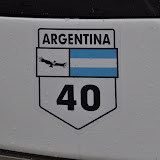
Route 40 is Argentina's longest highway.  It stretches from the north of the country all the way south along the western edge.  Its famous in the same way our Route 66 is famous, huge long highway across the largely untamed country.  Its still mostly just a “ripiro” or dirt road and the trip to Bariloche to our next destination, Chalten took 2 full days of driving.  Most people just fly but we had the time and it was just slightly cheaper than flying.
Ruta 40- Headed South

I think the thing that amazed me most about the trip is how much wildlife we saw on the way down.  You'll see some of the pictures but Patagonia looks and feels like a total wasteland.  There are no trees and the vegetation that survives is the very tough and usually dead-looking tufts of grass and tiny hardy plants that go on for miles and miles.  But as I said, we saw tons of life.  Alpacas were constantly on the side of the road as were sheep.  We also saw an armadillo sort of animal, some flamingos, ostriches, ducks, jackrabbits, and lots of birds (we think they might have been condors).  I think some reasons for seeing this diversity is that we couldn't go faster than 40 km/hr on the dirt road and the roads aren't generally the death traps that they are for animals when they're paved.

The tour also included a tour of the “Cueva de las manos” or “Cave of the hands” which is an UNESCO world heritage site where the natives a long time ago did a lot of rock art on these cave walls.  The interesting thing is that the main feature, the hands, were painted in the same way you would spray paint a hand.  They got their pigments into a dust, put their hands on the wall, and then put the paints in a hollowed out bone and with their mouth blew over their hands, creating a stenciled hand on the wall.  It was very interesting and I thought of my Mom and her studies of rock art out in New Mexico.  I think she would like this place a lot.
Cuova de las Manos


Chalten
Chalten is the “Trekking capital of Argentina”.  It sits on the north end of a national park dedicated to the glaciers.  It's main attraction is Mount Fitz Roy which is a very impressive set of spires jutting straight up from the ground.  Unfortunately for us the weather never did clear all the way so we only got an occasional glimpse of the mountain but we did get to capture some of the crazy weather that goes on here.  Both days we were here, in Chalten it was nice and sunny but up at the mountain it was always shrouded in clouds.  And the wind was like nothing I've experienced.  At Laguna Torres, which the site of our first day's hike, we were almost literally blown off our feet, which you can see in some video we shot in our photo album.  The wind here is pretty much constantly strong.

The second day we tried to get a view of Fitz Roy and headed up a different way.  However, as you can see, while we got some good shots, we didn't quite get to see the whole thing.  While we waited for it to clear, I got to make some time lapse movies of the clouds while we chatted with a young family from southern Colorado that we met.  Eventually, we gave up and headed back.  On the way back (as well as the previous day) we encountered some woodpeckers looking for food.

I think the more expensive and more touristy a place you go to, the more the locals dislike you.  I sense that here (the most expensive place we've stayed) where most of the locals are a lot more impatient and seem annoyed with the fact that you're even there.  I guess we can't help that, but its definitely something to remember as we head to places like Machu Pichu and the Galapagos.  So far we're going a little bit over our budget but we're hoping to make that up once we get to some of the cheaper countries (not Chile or Argentina).

El Chalten